
The living root bridges of Meghalaya are footbridges grown, not built: Khasi villagers guide the roots of rubber fig trees across a stream until they knit into a crossing that can carry dozens of people and keeps getting stronger for centuries. Here is where the bridges are, which one suits you, how hard the walks are and how to fit them into a trip, from a Shillong operator who drives travellers to the trailheads every week.
Quick answer
Meghalaya's living root bridges are in the Khasi and Jaintia Hills of north-east India, mostly around Cherrapunji (Sohra), about 2 hours from Shillong. The famous Double Decker bridge is at Nongriat, reached by about 3,000–3,500 steep steps down from Tyrna village and the same back up (a full day, 5–7 hours of walking). The easiest one is the Riwai bridge near Mawlynnong, a 10–15 minute walk from the road. Go October to April for dry steps; since June 2025 a registered local guide is required for treks in East Khasi Hills. Fly to Guwahati (GAU), then drive 3–3.5 hours to Shillong.
Ask Sia about Living Root Bridges of Meghalaya
Prices, plans and local tips from our Shillong team. Replies in seconds.
At a glance
Key facts at a glance
| Where | Khasi & Jaintia Hills, Meghalaya, north-east India |
|---|---|
| Made from | Aerial roots of the rubber fig (Ficus elastica) |
| Most famous | Double Decker bridge, Nongriat (near Cherrapunji) |
| Easiest to reach | Riwai bridge, Mawlynnong (10–15 min walk) |
| Double Decker walk | ~3,000–3,500 steps each way, 5–7 hrs total |
| Best months | October – April (dry steps, fewer leeches) |
| Guide | Registered guide required for treks since June 2025 (~₹500–800) |
| Nearest airport | Guwahati (GAU), then 100 km / 62 mi to Shillong |
What a living root bridge is
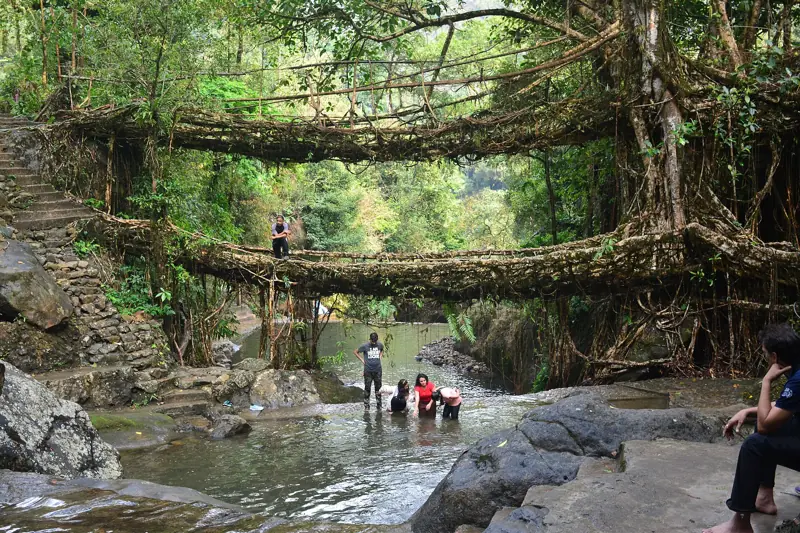
A living root bridge starts with a rubber fig planted on a riverbank. Villagers train its long aerial roots across the water, often along a frame of bamboo or betel-nut trunks, and keep weaving new roots in. After roughly 15 to 30 years the roots are thick enough to walk on, and from then on the bridge keeps growing. Some in use today are thought to be well over a century old.
The bridges are a Khasi and Jaintia tradition, made for one reason: monsoon rivers here wash away wooden bridges, while a living one gets stronger every year. Researchers have documented more than 70 of them across the hills, and in 2022 India added the "Jingkieng Jri" living root bridge landscapes to its UNESCO World Heritage tentative list.
Which bridge to see
Most visitors see one or two. The choice comes down to how much walking you want.
| Bridge | Near | Walk | Good for |
|---|---|---|---|
| Double Decker (Umshiang), Nongriat | Tyrna, Cherrapunji | ~3,000–3,500 steps down and up; full day | Fit walkers; the one in the photos |
| Ritymmen and Mawsaw bridges | On the Nongriat trail | Short detours from the same path | Seeing more bridges on the same day |
| Riwai single-decker | Mawlynnong village | 10–15 minutes each way | Families, older travellers, short trips |
- Pair Riwai with Mawlynnong (often called Asia's cleanest village) and the clear Umngot River at Dawki in one day from Shillong.
- Add Rainbow Falls (about an hour beyond Nongriat each way) only if you start very early or stay overnight in Nongriat.
How hard is the Double Decker walk?
It is all stairs: about 3,000–3,500 stone steps from Tyrna down to Nongriat, with two steel suspension bridges over rivers on the way, then the same climb back. Most reasonably fit people do it in 5–7 hours including a swim in the pools below the bridge. The climb back up is the hard part, and it is tough on knees.
Wear shoes with grip, carry water and a light rain layer, and start by 8 AM. Small shops on the way sell water and snacks. If you would rather not do it in one push, sleep in a simple homestay in Nongriat and walk out the next morning.
Rules since 2025: registered guides
Since June 2025, East Khasi Hills (which includes Cherrapunji and Nongriat) requires a registered local guide for treks and outdoor activities. Guides wait at the Tyrna trailhead and usually charge about ₹500–800 for the walk. It is money that stays in the village, and the guides know which paths are safe after rain.
When to go
October to April is best: dry steps, clear rivers and comfortable 10–25°C days. The monsoon (June to September) makes the falls spectacular but turns the steps slippery and brings leeches; the bridges stay open, but plan shorter walks. December and January mornings are cool, around 5°C in Shillong, so bring a warm layer.
Getting there from abroad
Fly into Guwahati (GAU), usually via Delhi (about 2.5 hours) or Kolkata (about 1 hour). From Guwahati it is 100 km (62 miles), 3 – 3.5 hours, by road to Shillong, then 54 km more to Cherrapunji. There is no train to Shillong. A private car with a local driver is the simplest way to reach the trailheads, which public buses do not serve well.
Our cars start from ₹4,560 a day for a sedan (fuel, tolls and driver included, whole car, not per person), up to ₹6,600 for an Innova. Most international visitors take a 5–7 day loop: Shillong, two nights in Cherrapunji for the Double Decker, and a day for Mawlynnong, Riwai and Dawki.
Good to know
Frequently asked questions
Where are the living root bridges in India?
In Meghalaya, a hill state in north-east India. Most are in the Khasi Hills around Cherrapunji (Sohra) and Mawlynnong, about 2 hours from the capital, Shillong; more are in the Jaintia Hills to the east.
How long does it take to see the Double Decker root bridge?
Plan a full day. The walk is about 3,000–3,500 steps down from Tyrna to Nongriat and back up, 5–7 hours with stops, plus the drive from Shillong (about 2 hours each way) or a short drive if you stay in Cherrapunji.
Is there an easy living root bridge?
Yes. The Riwai root bridge near Mawlynnong is a 10–15 minute walk from the road, fine for children and older travellers. It is a single-deck bridge, usually combined with Mawlynnong village and Dawki.
How old are the living root bridges?
They take roughly 15–30 years to become usable and then keep growing; some in use are believed to be more than a century old. Exact ages are rarely recorded.
Do I need a guide or permit?
No permit is needed to visit Meghalaya. Since June 2025 a registered local guide is required for treks in East Khasi Hills, including Nongriat; guides wait at the trailhead and charge about ₹500–800.
Are the root bridges a UNESCO site?
Not yet. In 2022 India placed the "Jingkieng Jri" living root bridge cultural landscapes on its tentative list for UNESCO World Heritage status.
 Up nextDouble Decker Living Root Bridge Trek: A Practical GuideStep-by-step plan for the Nongriat walk: start time, guides, Rainbow Falls.Read next (6 min)
Keep reading
Related guides
Local operator
Plan & book your trip
Tour Meghalaya runs private cabs and tour packages across Meghalaya. Book directly with a local operator.