Meghalaya is one of the easiest parts of Northeast India for an overseas visitor: no special permit, English widely spoken, and the living root bridges, cloud forests and clear rivers within a few hours of each other. This guide answers what travellers from abroad actually ask us, from visas and safety to cash, SIM cards and how to reach Nongriat, with the rule changes from 2025 and 2026 included.
Quick answer
Foreign tourists do not need an Inner Line Permit or a Protected Area Permit for the main sights of Meghalaya (Shillong, Cherrapunji/Sohra, the living root bridges, Mawlynnong and Dawki); a valid Indian visa and your passport are enough, and your hotel or homestay registers you as a foreign guest. Fly into Guwahati (GAU) and drive 3.5–4 hours to Shillong, or cross from Bangladesh at Dawki–Tamabil with a visa that allows it. English is an official language and widely spoken. Since July 2025, East Khasi Hills (which includes Sohra and the root bridges) requires a registered local guide for treks. Go October to April; carry cash outside Shillong. Meghalaya is generally safe and friendly for foreigners, with roads and monsoon weather the main risks.
On this page(13)ShowHide
- 1.Quick answer
- 2.Key facts at a glance
- 3.Do foreigners need a permit to visit Meghalaya?
- 4.Is Meghalaya safe for foreign tourists?
- 5.Guides: when a local guide is required
- 6.How to get to Meghalaya from abroad
- 7.Seeing the living root bridges
- 8.Money, SIM cards and staying connected
- 9.Getting around: drivers, shared taxis and scooters
- 10.A 7-day Meghalaya itinerary for first-time visitors
- 11.What a week in Meghalaya costs
- 12.Meghalaya, Sikkim or Bhutan?
- 13.Frequently asked questions
At a glance
Key facts at a glance
| Special permit for foreigners | Not needed for the main tourist areas (no ILP / PAP) |
|---|---|
| You need | Valid Indian visa (e-Visa works when flying in) + passport |
| Registration | Your hotel / homestay registers foreign guests; keep your passport with you |
| Nearest major airport | Guwahati (GAU), 3.5–4 hours by road to Shillong |
| Overland from Bangladesh | Dawki–Tamabil border, 9 AM–5 PM; needs a visa valid for that land port |
| Language | English (official), Khasi, Garo; Hindi understood |
| Guides for treks | Registered local guide required in East Khasi Hills since July 2025 |
| Best season | October – April (dry, clear rivers); June – September is very wet |
| Money | ATMs and cards in Shillong; mostly cash beyond it |
Do foreigners need a permit to visit Meghalaya?
No special permit is needed for the places most travellers come for. Meghalaya is not an Inner Line Permit state like Arunachal Pradesh, Nagaland or Mizoram, and Shillong, Sohra (Cherrapunji), the Nongriat root bridges, Mawlynnong and Dawki do not need a Protected Area Permit. You need a valid Indian visa and your passport, and you should carry the passport (or a copy plus the original nearby) on day trips, as police and some sites ask for ID.
Hotels and homestays across India register foreign guests with the police, and Meghalaya also asks accommodation to register guests through the state tourism app, so give your host your passport and visa details at check-in. A few areas right on the Bangladesh border have their own restrictions; if you plan to go off the usual circuit, ask us or check with the district office first.
Rules here are changing. In July 2026 the state announced plans for a registration system for all visitors entering Meghalaya. It was a plan, not yet in force, when we last checked; we will update this page when it starts.
- No Inner Line Permit (ILP) for Meghalaya
- No Protected Area Permit for the main tourist circuit
- Indian visa + passport; keep the passport with you
- Your accommodation registers you as a foreign guest
- Border villages can have extra restrictions: ask before you go
Is Meghalaya safe for foreign tourists?
For most travellers, yes. Meghalaya is calm, Christian-majority and English-speaking, and locals are used to visitors; crime against tourists is rare. The real risks are practical: steep, winding roads, fog, landslides in the monsoon, and slippery steps on treks. Travel by day on hill roads, use a local driver, and do not trek alone.
Government advice varies by country. The US State Department, for example, requires its own staff to get permission to travel outside Shillong in Meghalaya, while the UK Foreign Office reserves its strongest warning in the region for neighbouring Manipur. Read your own government's current advice before you book, and check our live travel updates for road closures, strikes (bandhs) and festival days before each day out.
- Low crime against tourists; English widely spoken
- Main risks: hill roads, fog, monsoon landslides, slippery trek steps
- Avoid driving the hills after dark
- Check your government's travel advice and our daily road updates
Guides: when a local guide is required
In June 2025 the East Khasi Hills district, which includes Shillong's surroundings, Sohra and the root bridge treks, ordered that tourists must use a registered tourist guide for treks and outdoor activities, after a widely reported case involving visitors. Tourism officials said it would be enforced, and guides now wait at the main trailheads such as Tyrna for the Nongriat trek, usually for about ₹500–₹800.
Some sites have always required a local guide: the Mawphlang Sacred Forest can only be entered with a village guide. Even where it is not enforced, a guide is worth it on the longer treks for the stories, the safest route and help if the weather turns.
How to get to Meghalaya from abroad
Most visitors fly into Guwahati (GAU) in Assam, usually via Delhi, Kolkata, Bengaluru or Mumbai, then drive 3.5–4 hours to Shillong. Shillong's own small airport at Umroi has only a few domestic flights, so check those before relying on them. India's e-Visa works for flying in through Guwahati and other major airports.
Coming overland from Bangladesh, the Tamabil–Dawki crossing near Sylhet is open roughly 9 AM to 5 PM and is used by foreign travellers. India's e-Visa is accepted only at designated entry points, so check that your visa allows entry at Dawki before you plan this route, and cross early in the day. From Dawki it is about 3 hours to Shillong by car.
| Route | Time | Notes |
|---|---|---|
| Guwahati Airport (GAU) → Shillong | 3.5–4 hrs by car | Most common; pre-book a cab to skip arrivals haggling |
| Guwahati city / railway station → Shillong | 3–3.5 hrs | Shared taxis from Paltan Bazaar, or a private cab |
| Shillong Airport (Umroi) → Shillong | ~1 hr | Few flights; check schedules |
| Dawki border (from Sylhet) → Shillong | ~3 hrs | Visa must allow entry at this land port; crossing ~9 AM–5 PM |
Seeing the living root bridges
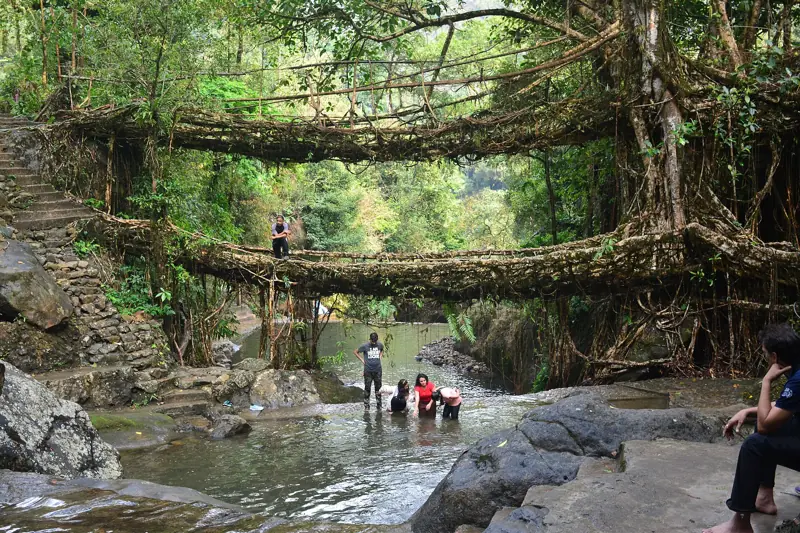
The famous Double Decker root bridge is at Nongriat, below Tyrna village about 30 minutes past Sohra. The trail is roughly 3,000–3,500 stone steps down and back up, about 3 km each way, with two steel suspension bridges; allow 5–7 hours for the return trip, or stay a night in a Nongriat homestay and continue to Rainbow Falls the next morning. Entry and camera fees are small, paid in cash.
If you cannot manage the steps, the Riwai root bridge near Mawlynnong is a short, easy walk and pairs well with Dawki on the same day. Local reports differ on whether the Nongriat viewpoints close on Sundays, as many Khasi villages keep Sunday as a rest day; plan the trek for a weekday to be safe.
- Double Decker (Nongriat): ~3,000–3,500 steps, 5–7 hours return
- Start from Tyrna by 8 AM; carry water and cash
- Riwai (near Mawlynnong): short and easy alternative
- Do the big trek on a weekday, not a Sunday
Money, SIM cards and staying connected
Shillong has plenty of ATMs and many shops take cards. Beyond the city, homestays, boatmen, guides and village cafés are mostly cash-only, and ATMs in Sohra and Dawki are few and often empty. Withdraw enough in Shillong or Guwahati before each day out.
UPI, India's phone payment system, is everywhere. Foreign visitors can use the UPI One World wallet, available at some major Indian airports and through apps, but keep cash and a card as backup. For a local SIM, bring your passport and visa; Airtel and Jio work well in Shillong and Sohra, while signal is weak to absent in Nongriat, Mawlynnong and parts of Dawki, so download offline maps first.
- Withdraw cash in Shillong; villages are mostly cash-only
- UPI One World wallet works for foreigners; keep a card as backup
- Local SIM: passport + visa; Airtel / Jio best in towns
- Download offline maps before Nongriat, Dawki and Mawlynnong
Getting around: drivers, shared taxis and scooters
There are no trains in Meghalaya and buses do not reach most sights, so the usual way to travel is a private car with a local driver, by the day or for the whole trip. Shared taxis link the towns cheaply but leave only when full and do not go to the viewpoints or trailheads.
Since 2025, renting private cars or bikes is illegal in Meghalaya unless the operator is registered with the Transport Department. If you want to ride, rent only from a registered operator and bring your home licence plus an International Driving Permit.
A 7-day Meghalaya itinerary for first-time visitors
Seven days covers the highlights without rushing, with the hardest trek in the middle when you are rested. Distances are short but roads are slow, so plan on 2–3 hours of driving on the longer days.
| Day | Route | Highlights |
|---|---|---|
| 1 | Guwahati → Shillong | Umiam Lake on the way; evening in Police Bazaar |
| 2 | Shillong | Laitlum Canyons, Mawphlang Sacred Forest (with village guide), Elephant Falls |
| 3 | Shillong → Sohra | Mawkdok valley, Wah Kaba, Nohkalikai Falls, Mawsmai Cave; stay in Sohra |
| 4 | Sohra → Nongriat | Double Decker root bridge and Rainbow Falls; stay in Nongriat or return to Sohra |
| 5 | Sohra → Mawlynnong → Shnongpdeng | Riwai root bridge, Mawlynnong village; riverside camp |
| 6 | Dawki → Shillong | Morning boat ride on the Umngot; or cross to Bangladesh |
| 7 | Shillong → Guwahati | Fly out from GAU in the afternoon or evening |
What a week in Meghalaya costs
Meghalaya is good value by international standards. These are typical prices for 2026; homestays and guides vary with season and demand.
| Item | Typical price |
|---|---|
| Private car + driver, full day | From ₹4,560 per car (Dzire) |
| Guwahati Airport → Shillong cab | From ₹3,000 per car |
| Homestay / guesthouse, double room | ~₹1,500–₹4,000 per night |
| Meal at a local café | ~₹150–₹400 per person |
| Trek guide (Tyrna / Nongriat) | ~₹500–₹800 |
| Entry fees (caves, falls, parks) | ~₹20–₹100 per site, cash |
| Dawki boat ride | ~₹500–₹800 per boat |
Meghalaya, Sikkim or Bhutan?
All three are green, mountainous and easy to love, but they suit different trips. Meghalaya is lower and wetter, with caves, rivers, waterfalls and the root bridges instead of snow peaks, and it needs no special permit for foreigners. Sikkim offers Himalayan views and monasteries but needs a Restricted Area Permit for foreigners and further permits for North Sikkim. Bhutan charges international visitors a daily Sustainable Development Fee on top of a guided-tour setup.
Many overseas travellers combine Meghalaya with Kaziranga National Park in Assam, about 6 hours by road from Shillong, for rhinos and elephants.
Good to know
Frequently asked questions
Do foreigners need a permit to visit Meghalaya?
No special permit is needed for the main tourist areas: no Inner Line Permit and no Protected Area Permit for Shillong, Sohra, the living root bridges, Mawlynnong or Dawki. You need a valid Indian visa and your passport, and your hotel or homestay registers you as a foreign guest.
Is Meghalaya safe for foreign tourists?
Yes, for most travellers. Crime against tourists is rare and English is widely spoken. The main risks are winding hill roads, fog, monsoon landslides and slippery steps on treks. Check your government's current travel advice and local road updates before travelling.
Can I use an e-Visa to visit Meghalaya?
Yes, when you fly in through Guwahati or another major Indian airport. If you plan to enter overland from Bangladesh at Dawki–Tamabil, check that your visa type allows entry at that land port before you travel.
Is a guide mandatory for the living root bridge trek?
Since July 2025 the East Khasi Hills district, which includes Sohra and the Nongriat root bridges, requires tourists to use a registered local guide for treks. Guides wait at Tyrna and usually charge about ₹500–₹800.
Do people speak English in Meghalaya?
Yes. English is an official language of Meghalaya and is widely spoken in Shillong, Sohra and by drivers, guides and homestay hosts. Khasi and Garo are the main local languages.
How do I get from Guwahati Airport to Shillong?
By road, about 123 km and 3.5–4 hours. A pre-booked private cab starts at ₹3,000 for the whole car and the driver meets you at arrivals; shared taxis leave from Guwahati city rather than the airport.
Can I pay by card in Meghalaya?
In Shillong, often yes. Outside the city most homestays, boatmen and small cafés take only cash or UPI, and ATMs are scarce, so withdraw cash in Shillong before day trips. Foreign visitors can use the UPI One World wallet.
When is the best time for foreigners to visit Meghalaya?
October to April, when it is dry, the rivers at Dawki are clear and the treks are safer. June to September brings some of the heaviest rain on earth: spectacular waterfalls, but slippery trails and road delays.
Can I rent a scooter or car to drive myself?
Only from an operator registered with the Meghalaya Transport Department; private rentals have been illegal since 2025. Bring your home licence and an International Driving Permit. For long hill drives, most visitors prefer a car with a local driver.
Local operator
Plan & book your trip
Tour Meghalaya runs private cabs and tour packages across Meghalaya. Book directly with a local operator.
Keep reading